ABBEY STATION.
As early as 1865 the railway contractor Richard Samuel France was planning a line from Abbey Station as part of a grandiose scheme to provide a shorter sea route to Ireland than that via Holyhead, by using Nevin, a small port on the Caernarvon coast. Several rival proposals eventually amalgamated and gave themselves the ambitious title of “THE POTTERIES, SHREWSBURY AND NORTH WALES RAILWAY” – ‘The Potts’. The GWR and the LNWR refused to allow the PS&NWR to use the General Station and it therefore built its own station – originally named ‘Shrewsbury Abbey Station’ on Abbey Foregate.
The line from there to Llanymynech was opened in August 1866. By then the route to Holyhead had opened and the financial crisis of the 1860s led to the abandonment of the connection to Stoke-on-Trent. The PS&NWR had to remain a small concern serving a quiet country district with a branch to the extensive quarries at Criggion. The line pottered on until it became bankrupt and closed in 1881. The ‘Potts’ continued in a state of suspension until 1908, when Colonel Holman Fred Stephens took charge. He used the recent Light Railway Act to reconstruct the line and it re-opened in April 1911 as the “SHROPSHIRE AND MONTGOMERYSHIRE LIGHT RAILWAY”.
Colonel Stephens personally owned the Snailbeach District Railway in Shropshire from 1923 and both the SDR and the Shropshire and Montgomeryshire Light Railway had their ‘day to day’ issues dealt with from Abbey Station. Second-hand and two new locomotives were purchased, a diminutive 0-4-2 WT, an ex Royal coach dating from 1844, an ex London single deck tramcar and a set of Model T motor buses on railway wheels. Colonel Stephens died on 1931 and in November 1933 the passenger service ceased. Stone traffic from Criggion continued.
In 1941 the line was taken over by the War Dept and run by the Army to service a vast series of ammunition depots built on 23sq miles of countryside around Kinnerley and Nesscliffe. The line had never been busier or better run. More modern coaches were used to transport the many workers from Shrewsbury. After the war the Army began to close the depots. The stone traffic from Criggion ceased in December 1959.
In 1960 the line was released to BR for dismantling but a link was put into the end of the Severn Valley line to Abbey goods yard which became an oil depot. This continued until 1988 when the last part of the line finally closed.
Shrewsbury Railway Heritage Trust has overseen the restoration of Abbey Station. which opened in 1866. Its use as a regular passenger station ended in 1933 and over succeeding years it deteriorated and became a derelict ruin. It was about to be demolished when the Trust stepped in, under the leadership pf Councillor Mansel Williams and a committee of volunteers. Both the town and county councils funded the rebuilding and the Station re-opened in September 2015. Abbey Station is available for use by local community groups, and charities, mainly for meetings, and exhibitions.
Shrewsbury Railway’s Scene. Shrewsbury was one of the most important railway towns in the West Midlands and it employed a large number of families some of whom still live in and around the town. the railway was one of the mainstays of the local economy. It brought new economic developments and an increase in population to Shrewsbury with the creation of many jobs. Many local families had some railway connections.
At it’s peak 500 people worked at the station alone with an even higher number at the engine sheds at Coleham. Sadly no trace of the sheds remain, although the local residential area there is still referred to as “The Back of the Sheds”. Over many years, Shrewsbury Borough Council had a strong representation of railwaymen among it’s councillors and several were mayors of the town.
Shrewsbury station was the centre of commercial activity and opened ’24 hours a day’ throughout the year, with express trains and were freight marshalled here and sent to all parts of the country, day and night. The station building was built of local Grinshill stone and in 1902 the building was radically changed.
Platforms were extended and widened over the river bridge by construction of two steel bridges either side of the original brick bridge. This involved the removal of about 50,000 tons of earth, as were the cellars. Shrewsbury Station is one of the finest examples of large scale Victorian arcihtecture in Shropshire and it’s opening in October 1848 coincided with the county’s first main line passenger railway service between Shrewsbury and Chester. The Station Master controlled hundreds of staff and made frequent visits to the platform’s to talk to passengers in his top hat! There were three refreshment rooms and a “refreshment hamper” service was available for long journeys. There was also a 24-hour refreshment centre frequented by railway and office staff the known as the “Coffee Tavern” .
The station’s importance as a ‘top rail junction’ continued throughout the early to the mid 1900’s and it became one of the most important changeover points for engines working the north and west of England Expresses. This made the Coleham sheds of major importance to the region where pride was matched by the keen rivalry between the drivers and footplate men who operated the engines of the two big Companies, the GWR and LNWR (later LMS).
Locomotives at Coleham were kept in prestine condition, the green of the Great Western “Kings” and “Castles”, with their copper caps and brasses gleaming, ran alongside the crimson lake and black of the other railway companies. In the 1950’s a day trip to the seaside was commonplace by train. All train travel to and from the town was a delight; there were through trains to Liverpool, Manchester, Birkenhead, London (Paddington), Dover, Bristol, Bournemouth, Plymouth via Newton Abbott and onto Penzance. The Severn Valley branch line operated between Shrewsbury and Kidderminster via Bridgnorth. Lines to Central Wales and Aberstwyth, and to the North Wales Coast carried passengers from London and other major cities.
A passenger branch line served Pontesbury and Minsterley. Thousands of tons of freight were moved every day including livestock. Calves and sheep sent by rail were usually fed and watered at Coton Hill yard or unloaded at Castle Foregate Goods Yard and paraded down to the Smithfield Livestock Market. Even the circus came to town by rail and was unloaded at Howards Bank or Underdale Road.
The Travelling Post Office had a base in the town. The overnight Shrewsbury – York T.P.O. workers had lodgings here, but this service ceased in the 1980’s and rail by mail is no more, the conveyor from the station to the sorting office erected in 1964 was removed in 2004. Parcels were delivered by road from the station to ‘your door’.
By March 1967 regular steam workings ceased, rationalisation was taking place with the growth of the family motor car; the Paddington to Birkenhead service was axed and we ended up with one through train to London (Euston) a day, which did increase in frequency over the years until the town lost the ‘through train’ by 1994, when Railway Privatisation came about. We lost our through trains from Manchester, Liverpool to Plymouth via the Marches route in 1970, but with the resurgance of train travel at present with increase in capacity. There is still a service from Manchester to Cardiff.
The Severn Bridge Junction Signal Box still controls the operations in and out of the south end of the station within the triangle. This is now the worlds largest surviving mechanical signal box and is Grade 1 listed. It celebrated its centenary in 2004 and has had a major refit and repaint thanks to Network Rail.
On 28th April 2008 the town had a new through service to London (Marylebone) with a direct service from Wrexham via Salop to Marylebone, but this ceased operation from 31st January 2011. Heavy freight including imported coal still passes through the town, but the small goods yards have now disapeared. The town still has a promising rail future.
- We welcome any historic artefacts, including photographs for loan or donation to the Trust. Please contact abbeystationshrewsbury@gmail.com or write to tHE cHAIRMAN, Abbey Station, 192A Abbey Foregate, Shrewsbury, SY2 6AH
Locomotives: GW “Castle” 4-6-0s were the premier locos that were kept in prestine condition on the GW side of Coleham sheds. To visit the site of an ex GW loco that used to work from Shrewsbury in the 1960s, click on the link below-
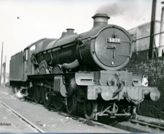
5029 Nunney Castle on Shrewsbury shed in 1960. (R.Amies).
Archive Collection.
A large number of Negatives has been donated to the Trust, that were taken by the late Mr Downes , taken around Shrewsbury in the 1930s.

An unidentified GW Bulldog 4-4-0 passes under the signal gantry at Abbey Foregate, whilst a railway official is coming from the signal box.

An LMS 2-6-4T carries out a shunting manoeuvre at the south end of station avoiding line. The LNWR signals lasted until the late 1970’s.

GW Castle at the stations southerly approaches.

An LMS Royal Scot 4-6-0 negotiates Crewe Junction.

A GWR “Hall” 4-6-0 soon after passing Sutton Bridge Junction makes a start at the climb with a North to West express, Shelf Sidings at nearby Sutton Bridge are on the right.
 Shrewsbury Railway Heritage Trust
Leave a comment